How a Big Tree Comes Out of a Tight Yard
A tree beside a house, a fence and a power line can't be dropped like one in an open field, so it comes down one piece at a time.
October 16, 2026 · 4 min read
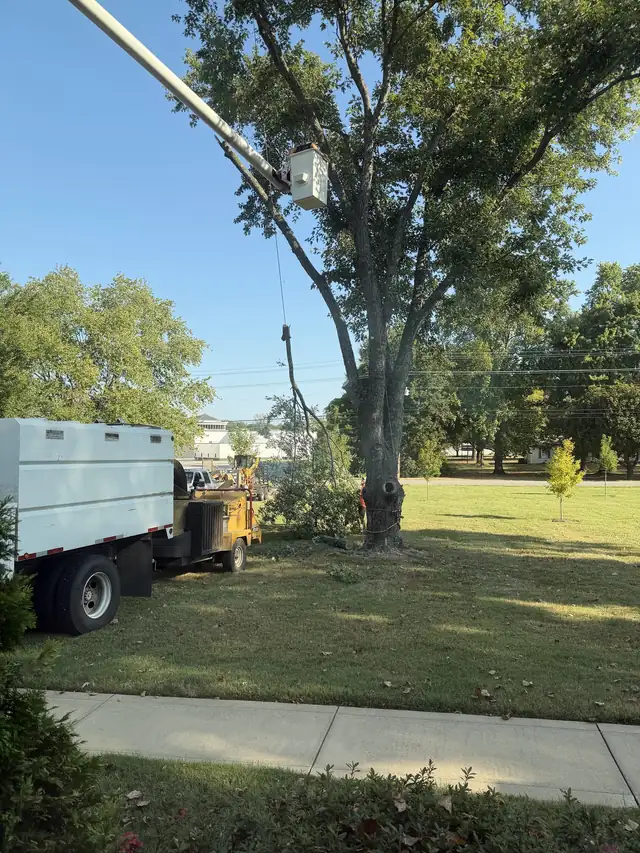
In an open field, you can notch a tree, cut the back, and let it fall. In a suburban yard, with a house on one side, a fence on the other, and a driveway or power line in the way, that doesn't work. A tree that tall has nowhere safe to land. So it comes down in pieces, from the top, with each piece controlled until it reaches the ground. It is called sectional removal, and it is how most big trees near homes are handled.
It starts with a walk-around
Before a saw is started, the crew studies the tree and the space around it. They look at the lean, the shape of the crown, how the weight is distributed, and whether there is any decay or dead wood that would change how the tree behaves when it is cut. They look at what is underneath and nearby: roofs, fences, sheds, septic lids, irrigation heads, cars, play sets. And they look up, for wires.
From that walk comes the plan. Where will the crew set up? Where can the equipment reach? Which pieces go first? Where does each piece land? The plan matters as much as the cutting. A rushed plan is where damage to a roof or a fence comes from.
Getting to the top: bucket truck or climber
There are two ways to work high in a tree. A bucket truck has a boom that lifts a worker in a platform to the height of the work, and it is fast and stable when the truck can get close enough. When the truck can't reach, a trained climber goes up using ropes and a harness. Either way, the idea is the same: work from the top down, so the person cutting is never standing under pieces still above.
A bucket truck is especially useful in a tight yard, since the boom lets the worker reach over fences and around obstacles from a spot on the street or driveway. The truck needs firm ground and enough room to set its stabilizers, so the crew checks that first.
Rigging: how the pieces come down safely
This is the part that makes sectional removal different from just cutting a tree up. Each limb or section is attached to a rope before it is cut. The rope runs through a pulley or around a strong anchor point higher in the tree, and a ground crew member holds the other end. When the cut is made, the piece doesn't fall. It swings or lowers under control, slowing as the rope is let out around a friction point.
That control is what lets a crew take a big limb off a tree that is hanging over a roof without touching the shingles. The heavier the piece, the more rigging goes into it. A large limb may be cut in smaller lengths so it doesn't overload the rope, and the ground crew may use more than one person or a vehicle-anchored line to hold it.
The order of the cuts
- Smaller branches come off first, so the crew can see the structure of the tree
- Large limbs are roped, cut and lowered, working from the top down
- The trunk is taken in sections, each one controlled on the way down
- The last piece, the base of the trunk, is dropped or lowered once it is short enough to be safe
Each of those steps might look slow from the porch. That's by design. The slower and more controlled the piece, the less damage there is to your yard.
Protecting the lawn and the structures
Heavy pieces and heavy machines are hard on grass. Crews often spread the load with boards or ground-protection mats under the wheels and under the area where logs land, so the lawn doesn't get rutted. Fences, gutters and flower beds can be shielded or worked around. If there is something fragile near the drop zone, tell the crew. They can't guard against what they don't know about.
Cleanup and what happens to the wood
After the tree is on the ground, the real volume shows up. Limbs and brush go through a chipper. The trunk sections are cut into lengths that can be loaded and moved. The yard is raked and blown clean, and the site is checked for debris.
Quality First Tree Service hauls away the wood and debris it takes down and recycles it, so you aren't left with a pile in the yard. Whether the stump comes out the same day is a decision to make in the estimate. They also grind stumps, so the whole job can be handled by one crew.
What you can do to help on the day
A little preparation makes the work go smoother. Move cars out of the driveway and off the street in front of the house, because the truck and chipper need room. Keep children and pets inside. Clear any items from the drop zone, like lawn furniture, toys and potted plants. And walk the crew through anything buried or fragile in the yard, such as sprinkler lines, a septic tank, or a pet's grave marker.
If you have a big tree in a tight spot and aren't sure how it could come down safely, Quality First Tree Service in Columbia offers free estimates and follows up within one business day. Their work is licensed, bonded and insured. Call (931) 374-8450 and ask them to take a look at the tree and the space around it.
Quality First Tree Service, (931) 374-8450
Call (931) 374-8450More articles
Signs a Tree Near Your House Needs an Arborist's Look
Most trees near a house are fine, but a handful of warning signs are worth a closer look before a storm tests them.
A Storm Dropped a Limb or a Tree: What to Do First
The first hour after a storm is about not getting hurt, and most of the work is waiting for the right people.