A Storm Dropped a Limb or a Tree: What to Do First
The first hour after a storm is about not getting hurt, and most of the work is waiting for the right people.
October 16, 2026 · 4 min read
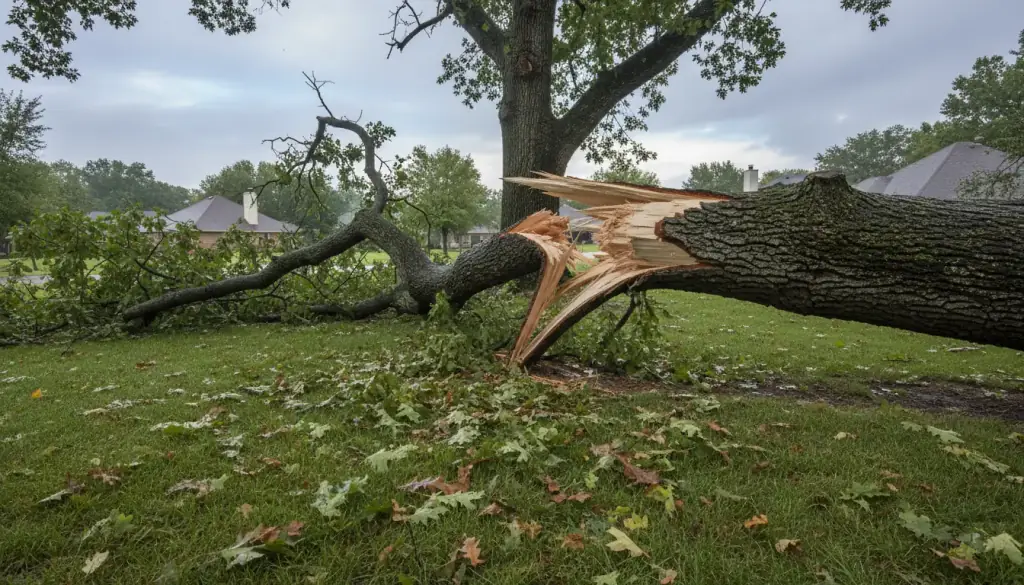
The wind dies down, you step outside, and there is a limb across the yard. Or a whole oak lying across the fence. Or something heavier resting on the corner of the house. The urge is to start dragging branches out of the way. Don't. The first hour after a storm is about not getting hurt, and the rest can wait for a crew that has the gear.
Check for power lines before anything else
Any line that is touching a fallen tree, tangled in its branches, or hanging near it should be treated as live. A line can carry current even when it looks dead, and a tree that is touching one can carry it too. Stay well back, keep children and pets away, and don't touch the tree or anything the tree is touching. If someone is hurt or something is on fire, call 911. For the line itself, call your power utility.
The utility owns and repairs its lines. A responsible tree crew won't start cutting near an energized line, so if wires are involved, expect the utility to deal with them first and the tree crew to follow.
Why you shouldn't climb or cut it yourself
Storm cleanup is where homeowners get hurt, because the job looks simple and isn't. Three hazards catch people.
First, hung limbs. A broken branch caught in the canopy above can come down with no warning when the wind shifts or when you move the tree beneath it. Arborists call these widowmakers for a reason. Don't walk or park under one.
Second, tension. A trunk or limb bent against another tree, a fence or the ground is loaded like a spring. Cut it in the wrong place and it can snap back or roll toward you. Telling where the wood is loaded and where it is safe to cut is a skill that takes years to learn.
Third, the ladder and saw. A chainsaw above shoulder height from a ladder, or with your weight on a branch you are cutting, is a bad plan on a good day. On wet ground under a damaged tree, it is worse.
What to do while you wait for a crew
- Stay out from under the tree and anything hanging above it, and keep children and pets inside
- Take photos from a safe distance before anything is moved, since you may want a record of the damage
- Move a car only if you can do it without going near the tree or any wires
- Note where the tree is touching the house, a fence, a shed or a line, so you can tell the crew exactly what they will find
- Make the call early, because crews work through the calls in order after a big storm
What an emergency crew actually does
A good emergency crew starts by walking the site, not by starting a saw. They are looking for lines, for weight resting on a roof or a wall, for wood under tension, and for hung limbs overhead. The order of the work comes out of that walk, and the order is the whole job.
Then the tree is made safe, piece by piece. Hung limbs are dealt with first so nobody works under them. Tension is released with small, careful cuts in the right spots. If the tree is resting on a house, the weight comes off in sections that are supported or lowered on ropes rather than dropped onto the structure. Only after that does the cleanup start: cutting the trunk into manageable lengths, clearing the crown, and hauling away the wood and debris.
Quality First Tree Service offers 24/7 emergency tree service in Columbia and across Maury County and Middle Tennessee, with clean-up of damaged or fallen trees and debris. Their wood and debris is hauled away and recycled.
Why a careful crew can look slow at first
If you watch a crew arrive after a storm, the first ten minutes may look like nothing is happening. People walk around the tree, look up, point, and talk. That is the real work. A crew that skips straight to cutting is gambling with your roof and with its own safety. The walk-around is what lets the cutting go fast and clean afterward.
After the tree is off the house
Once the main trunk is cleared, a few loose ends are worth handling. A tree that uprooted leaves a hole and a lifted mass of roots and soil, and that root plate can shift as it dries or after more rain. The stump of a snapped trunk may need grinding. And the trees that are still standing deserve a look too.
Storms stress trees that don't fall. Check the survivors for new cracks, split forks, limbs hanging by a strip of bark, and soil that has lifted at the base. A tree can look fine from the porch and still be holding on by less than it was yesterday. This is a good moment for a certified arborist to walk the yard and tell you which trees are fine and which ones need work.
If a storm has put a tree down on your property, or you have a damaged one you are worried about, call Quality First Tree Service at (931) 374-8450. Tell them where the tree is touching, whether any lines are involved, and whether anyone is hurt, and they can sort out the order of the work from there.
Quality First Tree Service, (931) 374-8450
Call (931) 374-8450More articles
Signs a Tree Near Your House Needs an Arborist's Look
Most trees near a house are fine, but a handful of warning signs are worth a closer look before a storm tests them.
Pruning vs. Topping: Why Cutting a Tree Back Hard Backfires
A tree that has gotten too big needs a thoughtful trim, and chopping the top off is the opposite of that.