Pruning vs. Topping: Why Cutting a Tree Back Hard Backfires
A tree that has gotten too big needs a thoughtful trim, and chopping the top off is the opposite of that.
October 16, 2026 · 4 min read
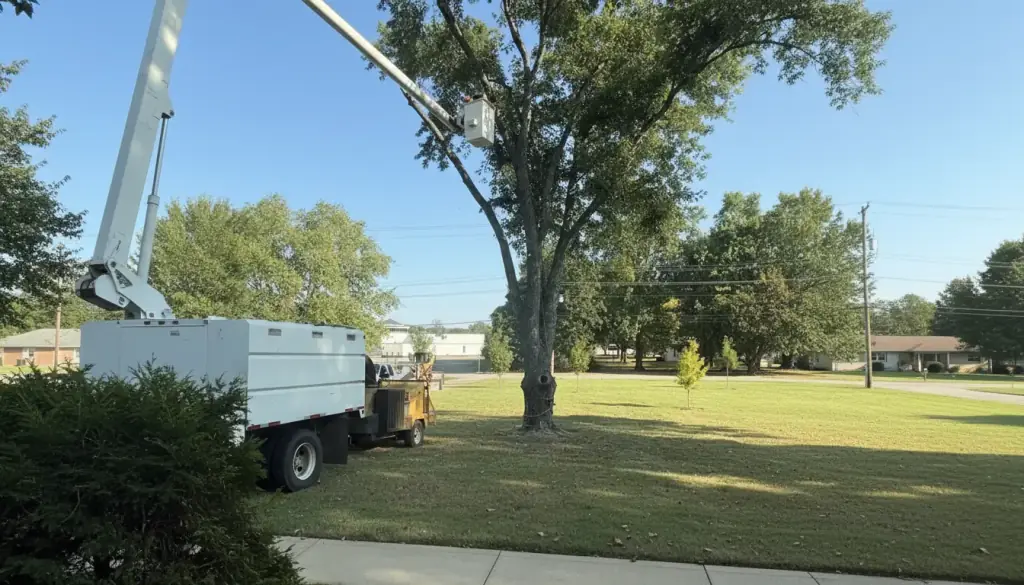
At some point most homeowners look at a tree and think it has gotten too big. It crowds the roof, it shades the garden, it makes you nervous in a storm. The tempting fix is to cut it back hard, take the top off, and call it done. That cut has a name, topping, and it is one of the most common ways a healthy tree gets damaged.
What topping is
Topping means cutting the main stems or large limbs back to stubs, usually with no regard for where a side branch grows. The tree ends up with a flat, blunt outline and a crown that looks like a row of fence posts. You see it on shade trees in neighborhoods, and the crape myrtle is the classic Southern example, cut to knuckles every winter for no good reason.
Why topping hurts the tree
A tree makes its food in its leaves. Remove most of the crown at once and you remove most of the tree's way of feeding itself, right when it needs energy to recover. The tree responds the way it always does when it is in trouble: it throws out a crowd of fast new shoots from just under each cut.
Those shoots are the second problem. They grow quickly, but they are anchored only in the outer layer of the old stub, not deep in the wood the way a natural branch is. Over time they are prone to breaking in wind and storms, which is the exact thing the topping was supposed to prevent. The big cut faces are a third problem, because large wounds are slow to close and can let decay in. A tree that took many years to grow can be set on a downhill path by one afternoon with a saw.
There is also a plain look-and-value issue. A topped tree looks mutilated, and it tends to stay that way.
What proper pruning looks like
Good pruning is selective. The arborist decides what the tree needs and removes only that, cutting back to a living side branch or to the branch collar, the slight swelling where a branch joins its parent. Cuts made there close over naturally. Cuts made in the middle of nowhere, leaving a stub, don't.
When a tree really does need to be smaller, the right tool is reduction pruning. The arborist shortens limbs by cutting back to a side branch large enough to take over as the new tip, which keeps the natural shape and keeps the tree growing in a sound way. A common rule of thumb is not to remove more than about a quarter of the living crown in a single year, and many mature trees do better with less.
Reasons to prune a tree
- Dead, broken or hanging branches that could fall
- Branches that cross and rub, wearing wounds into each other
- Limbs growing over the roof, the chimney or the service line
- Weight on a long, low limb that is starting to sag
- A crown so dense that light and air can't get through, which can be thinned selectively
- Clearance for the driveway, a walkway or a mower
When to prune common Tennessee yard trees
Dead and dangerous limbs can come off at any time of year. Don't wait for the right month to deal with something that could fall on a car. For ordinary shaping and thinning, though, timing helps.
For most shade trees, such as maples and many oaks, the dormant season in late winter is a good window. The leaves are off, the structure is easy to see, and the tree is about to put on a flush of growth that helps it close its cuts. Trees that bloom in spring, like redbud and dogwood, are usually better pruned right after the flowers fade, so you don't cut off this year's show. Crape myrtles can be thinned lightly in winter, and the right way to improve one is to take out crossing and crowded stems, not to chop it down to knuckles.
Species have their own quirks, and a few trees do better if they are cut during certain parts of the year. Ask the arborist about timing for your particular tree. That question is part of a good estimate.
Is a trim enough, or is the tree the wrong tree?
Sometimes the honest answer is that the tree is the problem, not the pruning. A species that grows very large, planted a few feet from the house, may never fit the spot no matter how carefully you trim it. A tree with serious decay or structural trouble may not be worth the money spent keeping it. In those cases a good arborist will say so and talk about removal, rather than selling you a topping that only postpones the same conversation.
It also helps to know what you are comparing. A free estimate should tell you which branches will come off, how large the cuts will be, and what the tree will look like afterward. If the answer is that the top is coming off, ask for a second opinion.
Quality First Tree Service in Columbia handles tree trimming and pruning, along with removal, stump grinding and certified arborist inspections, and they offer free estimates. If you have a tree you think has outgrown its spot, call (931) 374-8450 and have someone look at it before anyone picks up a saw.
Quality First Tree Service, (931) 374-8450
Call (931) 374-8450More articles
Signs a Tree Near Your House Needs an Arborist's Look
Most trees near a house are fine, but a handful of warning signs are worth a closer look before a storm tests them.
A Storm Dropped a Limb or a Tree: What to Do First
The first hour after a storm is about not getting hurt, and most of the work is waiting for the right people.